
Hiring Fraud Checks Verify Candidates, Never Recruiters
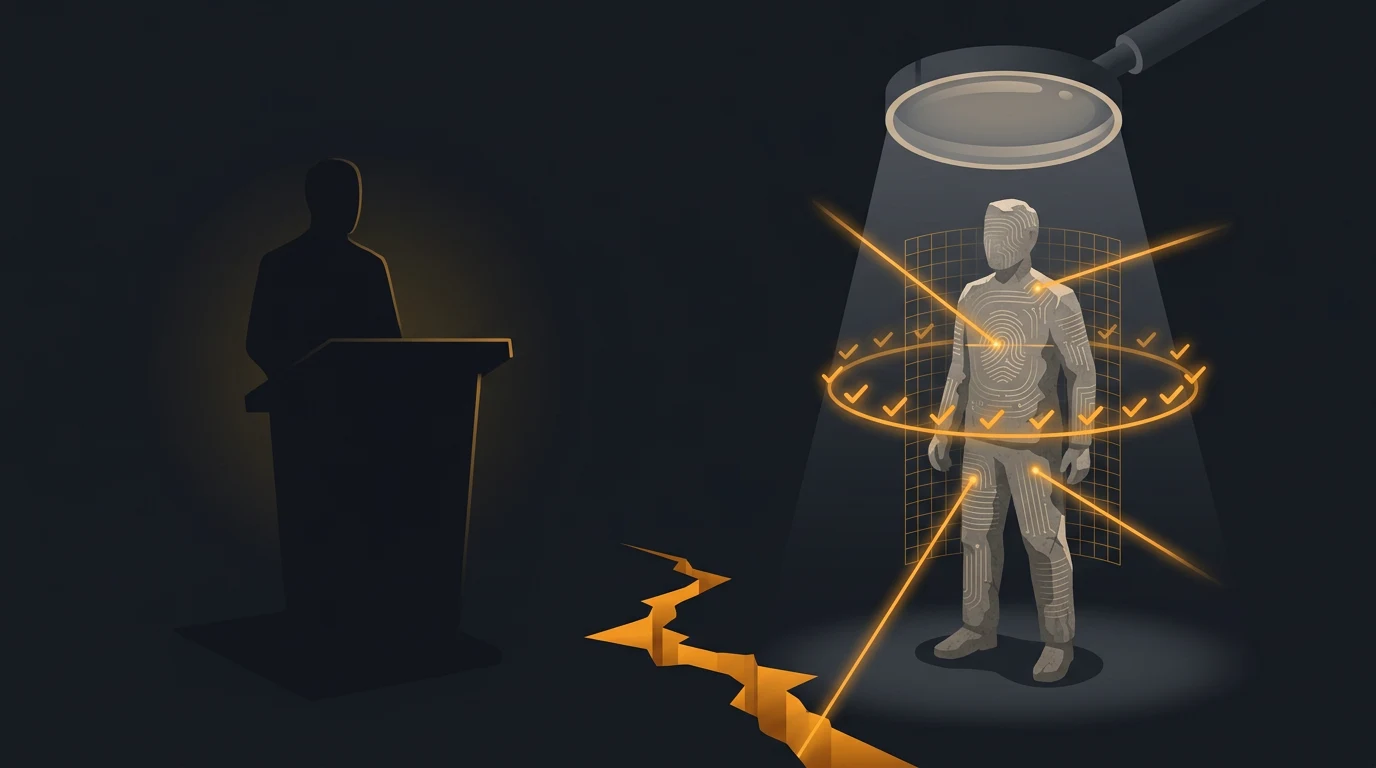
Recruiter verification doesn't exist as a category. Candidate verification is now a multi-vendor industry — notaries, biometric ID scans, live video checks — but nobody builds the mirror version: a way for a candidate to confirm the recruiter messaging them, or the job they're applying to, is real. That gap isn't an oversight. It's the shape of who the hiring-tech industry decided was worth protecting in 2026, and it tells you everything about whose risk gets funded.
The Verification Arms Race Has One Direction
Look at where the money and engineering effort actually went this year. Ontrac Solutions partnered with PinpointVerify to send a state-licensed notary to physically meet remote candidates, confirming human presence, location, and a name-to-ID match before a placement closes. The service is explicit that it isn't a background check — it doesn't verify employment history or credentials. It exists purely to confirm the candidate is a real body in a real room, for the employer's benefit.
Ontrac CEO Eric Fouarge put it plainly: "Adding PinpointVerify means every placement is verified in person, the standard our clients deserve." Notice the direction of that sentence. The client deserves verification. The candidate is the thing being verified.
The same pattern shows up at platform scale. Employ Inc. partnered with ID.me to embed identity checks directly into JazzHR, Lever, and Jobvite — the ATS stack a huge slice of tech recruiting already runs on. Employ's own Recruiter Nation data found 23% of recruiters have already experienced candidate fraud, and Employ's Chief Product Officer Dara Brenner framed the fix as necessary because "a resume or application are no longer the trusted signals they once were, and with the rise in AI, neither is a live interview." ID.me's Taylor Liggett went further: "AI has made faking a resume, a credential, even a live interview easier than ever — which means confirming who you're actually hiring is now essential." Every quote, every product, every dollar points the verification lens at the candidate.
Gartner's Buried Number: Half of Candidates Don't Trust the Job Itself
The stat driving this entire cycle is Gartner's prediction that one in four candidate profiles will be fake by 2028, built on a survey of 3,000 job candidates where 6% admitted to some form of interview fraud. That number has been repeated across the industry — it shows up again almost verbatim in background-check trade coverage justifying more identity checks and in-person assessments.
Buried in the same body of Gartner research, rarely quoted anywhere else, is the mirror-image finding: only half of candidates trusted that the jobs they were applying for were legitimate. Half. That's not a rounding error — it's a trust crisis identical in magnitude to the one the entire industry is racing to solve, except nobody is racing to solve it. The same research found only a quarter of candidates trust AI to fairly evaluate them, and that 62% of candidates said they'd be more likely to apply if a role required an in-person interview — a preference for human contact that reads less like enthusiasm and more like exhaustion with a process candidates no longer trust to be real. Gartner's own recommended response is a "multi-layered fraud mitigation strategy" — background checks, identity verification, anomaly alerts. Every layer points at the candidate. None of it verifies the job.
Compliance Protects Employers, Not Candidates
The regulatory response tells the same story from a different angle. uRecruits launched its 2.0 platform explicitly to keep a human in every hiring decision, citing Illinois' amended Human Rights Act — which took effect January 1, 2026 and requires AI-use disclosure — alongside NYC's bias-audit mandate and the pending Workday lawsuit testing employer liability for AI screening — the regulatory convergence we mapped across five regimes. Founder Thomas Alexander's framing is telling: "AI doesn't reject or approve anybody — that stays with people," a design built to protect the employer from liability, not the candidate from the black hole.
SHRM's coverage of AI hiring tools discriminating against real candidates adds the closest thing to a candidate-side concern in this whole batch — but even that framing is about legal exposure for employers running biased tools, not about giving candidates a way to know, in advance, whether the tool scoring them or the recruiter emailing them is legitimate. Volume-solving tech consistently optimizes for the employer's inbox, never the candidate's silence — that's the whole business model of spray-and-pray outreach, and no compliance mandate touches it.
The Legal Industry Sees Candidates as Risk Vectors, Never as Risk-Bearers
Even the lawyers frame this one-sided. NYSBA's coverage of fake job candidates treats deepfake impersonation as a cybersecurity and sanctions-compliance threat to employers, cataloging the mechanics — face swapping, voice cloning, synthetic identity fraud — purely as attack vectors employers must defend against.
Synthetic identity fraud: using a combination of personally identifiable information to fabricate a person or entity in order to commit a dishonest act for personal gain, as the Federal Reserve defines it.
Experian's 2026 Future of Fraud Forecast rates deepfakes outsmarting HR as the second-highest fraud threat facing businesses this year, and predicts the problem escalates as generative AI produces hyper-tailored resumes and real-time deepfake interviewees. Every legal brief, every forecast, every framework in this batch positions the candidate as the threat to be screened — never as the party who might reasonably want to screen a recruiter, a job posting, or an employer's outreach before handing over a government ID.
What Recruiter Verification Would Actually Look Like
Here's the honest counterargument: candidate fraud is real, costly, and rising — Gartner's numbers aren't manufactured panic, and a company burned by a deepfake hire posing a sanctions-evasion risk has a legitimate reason to want ID checks. Verification isn't the villain.
But asymmetric verification is. The fraud this industry chose to fund is the fraud that threatens employers' balance sheets, not the fraud that wastes candidates' time and dignity — fake postings, ghost recruiters, resumes vanishing into ATS black holes with no accountability on the other end. Candidates get treated as suspects for the same adaptive behavior employers treat as smart hiring practice when they do it. A system that demands notarized proof-of-human before a candidate can even be considered, but offers candidates zero equivalent proof that the job or the recruiter is real, isn't solving trust — it's allocating it in one direction only, and volume-based outreach is exactly what a system with no accountability produces at scale.
The closest things to counterexamples prove the point. LinkedIn now offers identity and workplace verification badges — built on primitives like Microsoft's Entra Verified ID — and the infrastructure for verifying a business registration or an employee's affiliation is mature, cheap, and API-shaped. What no one has assembled is protection at the moment it matters: verification never gates outreach. A badge doesn't stop an unverified "recruiter" from messaging a thousand people, doesn't tell you a posting isn't a ghost job, and costs nothing when it's absent. The parts bin is full; the product — verification as a precondition for reaching a candidate at all — remains unbuilt.
The fix isn't more disclosure from candidates. It's flipping the default: treat invisibility as the candidate's baseline protection, not a suspicious act to be overcome, and let verification — of the recruiter, the posting, the employer — be the thing that has to be earned before anyone's identity is ever on the line.
Frequently asked questions
- Why do companies verify job candidates but not recruiters or job postings?
- Because every fraud-prevention product built in 2026 — notarized ID checks, biometric verification, AI-detection tooling — was funded to protect employers from fake candidates, with no equivalent commercial incentive built to protect candidates from fake jobs or recruiters. That one-directional investment is the core asymmetry this post traces across the entire 2026 hiring-fraud coverage cycle.
- How can I tell if a recruiter or job posting is legitimate before applying?
- There's currently no standardized verification layer for this — candidates are largely stuck relying on manual checks like company domain matching and LinkedIn history, because no vendor in the current market builds trust infrastructure for the employer side. Gartner's own data found only half of candidates believe the jobs they apply to are real, yet that finding hasn't produced a single product to address it.
- What percentage of candidate profiles are predicted to be fake by 2028?
- Gartner predicts one in four candidate profiles worldwide could be fake by 2028, driven by AI-generated resumes and deepfake interview impersonation. That stat is the engine behind every notary, biometric, and ID-verification product covered in this piece — while its mirror-image finding, that half of candidates doubt job legitimacy, drives none.
Related
- AI Recruiting Agents Won't Fix Ghosting. Here's Why.
- Why AI Recruiting Tools Are Making Ghosting Worse, Not Better
- Sort, Don't Rank: The Line AI Hiring Law Is Drawing
- AI Hiring Fixes Miss the Real Problem: Recruiter Spam
- Ghost Jobs & Fake Resumes: Same Broken System, One Fix
- Is AI Resume Tailoring Candidate Fraud? The Real Answer
- 2026 HR Tech Boom Optimizes Speed, Not Candidate Consent