
Is AI Resume Tailoring Candidate Fraud? The Real Answer

No. AI resume tailoring is a human trying to get past an unjust keyword filter, and it's functionally identical to what Harvard Business School and Accenture already named and quantified back in 2021. The only thing that's changed by 2026 is that both sides of the transaction now have AI doing the work — recruiters use it to screen and, increasingly, to detect "fraud," while candidates use it to write around the screen. Line up the vendor announcements from this year against the five-year-old research and the pattern is impossible to miss: this isn't a new crisis, it's an old, unaddressed structural failure finally provoking a market response — and the response is more surveillance, not a better filter.
The 2021 Diagnosis Nobody Fixed
27 Million Hidden Workers
Hidden workers are qualified people actively looking for work who are screened out by automated hiring filters before a human ever sees their resume — a population Harvard Business School and Accenture put at 27 million in the US alone.
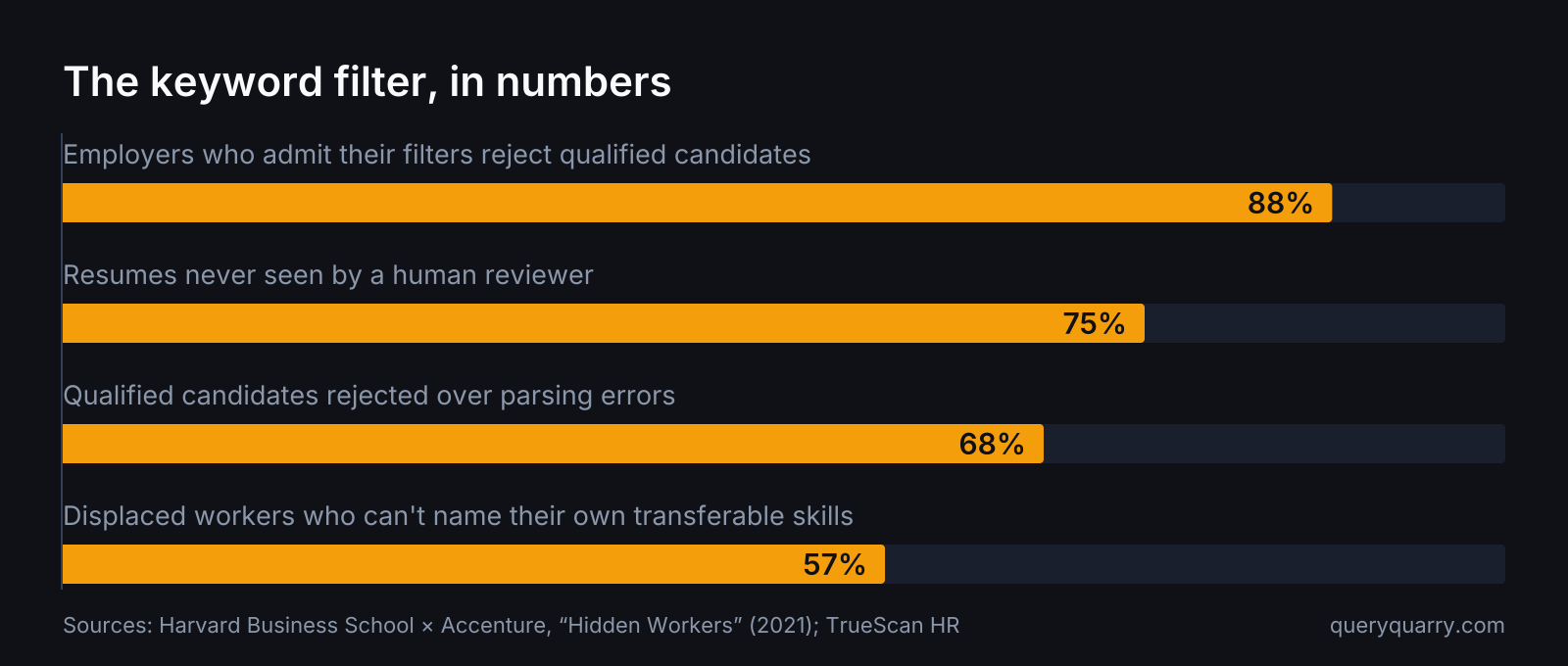
Harvard Business School partnered with Accenture in 2021 to study people who were actively job-hunting but systematically filtered out before a human ever saw their resume, a population they called "hidden workers". Across 8,720 hidden workers and 2,275 executives surveyed in the US, UK, and Germany, the numbers were stark: 27 million Americans shut out of jobs they were qualified for, 75% of resumes never reaching a human reviewer at all, and 68% of qualified candidates rejected purely on parsing errors. Harvard's Joseph Fuller put it bluntly: "The effort to make the process very efficient is creating a significant amount of the shortage that they complain about." The study named the victims specifically — veterans, immigrants, people with disabilities, people previously incarcerated — whose real-world experience simply doesn't map to the exact keyword strings an ATS is scanning for.
The Filter Is the Bug, Not the Candidate
This wasn't a fringe finding. The UN's human rights office called for a moratorium on recruiting AI that same year. Amazon had already killed its own hiring algorithm in 2018 after it penalized resumes containing the word "women's", and by 2024 Workday was facing a class-action lawsuit alleging age, gender, race, and disability discrimination in its screening tools — one plaintiff claims over 100 rejections from Workday-powered pipelines alone. The research also found the fault isn't just the software — job descriptions themselves list credentials far beyond what the role actually requires, pre-loading the filter to reject people who could do the job fine. Keyword matching was never a competence filter — it was a volume-management hack for inboxes that outgrew human review, and volume-management hacks always end up optimizing for the wrong thing. None of this is speculative anymore. It's litigated.
2026: Same Disease, Two New Vendors
Kyle & Co.: Fraud as Enterprise Security
This year, Kyle & Co. released "The State of Candidate Fraud Detection & Prevention" and hosted an executive session, "Who Owns the Seam?", reframing AI-assisted applications as an enterprise trust and security problem rather than a recruiting nuisance. Founder Kyle Lagunas argues "organizations that continue treating it as an HR issue alone will always be responding too late", and the report's core recommendation is governance: clear escalation paths and shared accountability across security, legal, and HR, because technology alone can't solve it. Note what's missing from that recommendation: any mention of fixing the keyword-matching logic that created the incentive to game the system in the first place. Governance dressed up as security is still just another layer of gatekeeping stacked on a broken filter — it doesn't reduce the noise, it criminalizes the response to it.
Jobloo: The Mirror Image
On the same publication day, a different outlet covered the launch of Jobloo, an AI job-application platform built to do precisely what Kyle & Co.'s governance layer is designed to catch — automatically adapt each candidate's resume to a specific job description using only information already in the original CV, then submit it. Jobloo's founder, Hicham Rabbaa, built the first version of this tool three years ago after a script he wrote to reword his own resume for ATS terminology landed him three interview invitations in a week, including one at Mirakl. The platform now supports Workday, Greenhouse, Lever, Ashby, SmartRecruiters, and iCIMS, indexes over one million job postings in 150+ countries, and cites the exact same 88% employer admission that Kyle & Co.'s counterpart report treats as a threat model. Same statistic, same broken filter, two opposite conclusions about who's the problem. The tell is what happens once the person on the other side of the ATS has access to the same optimization tools the employer does — the keyword gate stops being a gate and starts being a formality.
Who Gets Called a Fraud Risk?
To be clear, genuine candidate fraud exists — fabricated identities, deepfaked interview stand-ins, credentials that were never earned — and detecting it is legitimate security work. The problem is where the net is aimed: a detection layer tuned to flag “AI-assisted applications” cannot distinguish identity fraud from a truthful candidate rewording real experience, and the two get swept together.
The practitioners closest to the hiring floor are already flagging the collateral damage. Gartner data shows 68% of job seekers actually prefer a human touchpoint in the process, and a Workday survey found 93% of hiring managers still believe human involvement is essential even with AI tools running. Meanwhile 43% of organizations now use AI somewhere in recruitment, a gap between stated preference and deployed reality that's exactly where hidden workers keep falling through. Harvard's original research specifically flagged veterans as one of four hidden-worker categories whose experience doesn't translate into ATS keyword strings. Separately, 57% of displaced workers can't identify their own transferable skills and won't know to phrase their resume the way a bot wants it phrased — meanwhile recruiters report a 27% rise in candidates with six-month-plus employment gaps, and 68% of hiring managers admit they have no framework for evaluating those gaps at all. These are precisely the résumés a fraud-detection tool, tuned to spot "unnatural" keyword optimization, is most likely to misread as manipulation rather than desperation. Every fraud-detection layer trains candidates to write more convincingly, not more honestly — an arms race the filter cannot win, because it was never built to tell the two apart.
The Fix Nobody's Selling
Three responses are now on the market for the same root cause, and none of them touches the root cause. Kyle & Co. wants more governance layered onto hiring. Jobloo wants candidates armed with better AI to beat the layer underneath. ERE's practitioners argue for less automation and more actual human judgment — Elisha Zagerman notes her company's return to in-person final rounds produced a 16% jump in retention. All three are patches on top of a filter Harvard already proved doesn't work. And the cost of leaving it unfixed isn't abstract: SHRM estimates $500 a day in lost productivity per open role, a bad hire runs $17,000 on average, and applications per posting have climbed to 257 in 2026, up from 207 in 2024 — more haystack, same broken needle-finder. Calling AI-assisted tailoring "fraud" doesn't shrink the haystack. It just gives the filter a new excuse to keep swinging at qualified people — and a new justification for blaming the applicant instead of the process that made dishonesty the rational move.
Frequently asked questions
- Is using AI to tailor a resume for an ATS considered candidate fraud?
- No — using AI to rephrase truthful qualifications so they match a job description's keywords is optimization, not fraud, since no false information is introduced. Tools like Jobloo explicitly work only from data already in a candidate's real CV, which is the same behavior fraud-detection vendors are now building tools to flag.
- Why do applicant tracking systems reject qualified candidates?
- ATS software filters resumes by exact keyword and credential matches, so candidates with non-traditional backgrounds or transferable skills get rejected even when they can do the job. Harvard and Accenture found 88% of employers admit this happens, and that finding from 2021 remains the unaddressed root cause behind today's AI arms race between screening and resume-tailoring tools.
- What is the 'hidden workers' problem in recruiting?
- It's the term Harvard Business School and Accenture coined for the roughly 27 million qualified job seekers who get filtered out by automated hiring systems before a human ever reviews their application. Hidden workers like veterans and career-changers are the same population now at risk of being misidentified as 'fraud risks' by new detection tools aimed at AI-assisted applications.
Related
- AI Recruiting Agents Won't Fix Ghosting. Here's Why.
- Why AI Recruiting Tools Are Making Ghosting Worse, Not Better
- Should You Put Dates on Your Resume? What They Reveal
- Sort, Don't Rank: The Line AI Hiring Law Is Drawing
- Hiring Fraud Checks Verify Candidates, Never Recruiters
- Ghost Jobs & Fake Resumes: Same Broken System, One Fix
- The ATS Resume You Optimized Is Also a Surveillance Target