
Why AI Recruiting Tools Are Making Ghosting Worse, Not Better

AI recruiting tools increase candidate ghosting for a simple, unglamorous reason: they automate the part of hiring that was never broken and dump the overflow onto the part that was. Recruiters scale sourcing and outreach with platforms like Arbi. Candidates scale applications with homemade bots that automate LinkedIn's Easy Apply flow. Neither side is solving a shortage of matches — they're both feeding more matches into a funnel whose actual failure point, according to the industry's own diagnostic data, sits downstream at the human decision moment. More volume into a bottleneck doesn't relieve it. It just moves the jam, and it's the same jam every volume-first strategy eventually produces.
The Funnel Was Never Short on Volume
Start with the diagnostic nobody in the automation-vendor conversation seems to be reading. Cadient's analysis of 1,386 employers across 12 industries, run through its free HiringScorecard.ai tool, scored each employer on five dimensions: Career Page, ATS, Hiring Volume, Employer Brand, and Application Flow. The pattern was stark and consistent — Hiring Volume scored 7 to 9 out of 10 almost everywhere, while Career Page, ATS, and Application Flow scored 2 to 5. Roughly 75% of employers relied on manual or unstructured screening, and about 70% showed signs of high turnover or early attrition.
Read that plainly: employers have plenty of candidate interest. What they lack is anywhere for that interest to safely land, get screened, and turn into a decision. The bottleneck Cadient's own CEO, Bill Mastin, is diagnosing isn't a sourcing gap. It's a conversion and screening gap. Volume was never the constraint — it was already the surplus everyone kept mistaking for the problem.
Two Engines, Same Pipe
And yet volume is exactly what both sides of the market are racing to produce more of. On the recruiter side, Neuroscale AI's Arbi platform — built with DoD SBIR-funded infrastructure and pitched explicitly as a replacement for a recruiter's entire stack — promises sourcing, bulk evaluation, and "hyper-personalized" outreach at a scale no human team could match. Recruiters using it report real hires; the tool works as advertised. It generates more qualified-looking candidates, faster, than a team could generate alone.
On the candidate side, the mirror image is happening in public on GitHub. One developer, tired of retyping the same fields across hundreds of listings, built a Python-based Easy Apply bot using Selenium with dry-run and confirmation modes, rate limiting, and duplicate tracking. It's a careful, safeguarded piece of engineering — and its entire purpose is to submit more applications, faster, into the same ATS pipes Cadient just measured at 2-5 out of 10.
Both tools are rational responses to real friction. Neither one touches the actual constraint. They're two taps pouring into a drain that Cadient already told us is too narrow — and every escalation on either side just proves that outreach built on sheer volume is a race both sides eventually lose.
Why AI Recruiting Tools Increase Candidate Ghosting, Not Fix It
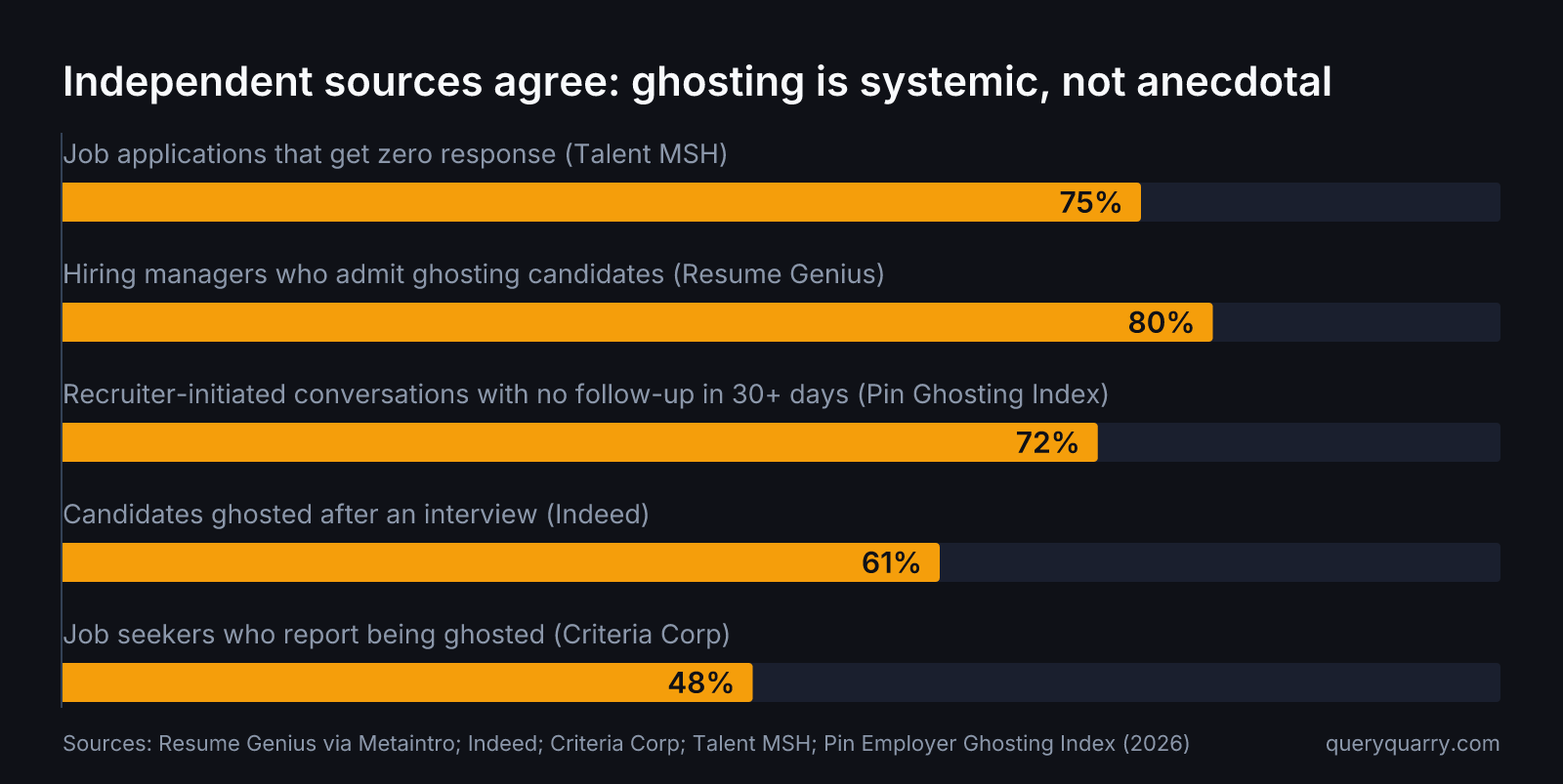
Here's where the overflow actually goes: onto a hiring manager's desk, at the exact moment they have to decide whether a candidate is worth a reply. Resume Genius data cited by Metaintro shows 80% of hiring managers admit to ghosting candidates, and — this is the load-bearing number — 81% say the reason is uncertainty about whether the candidate in front of them is actually their best option. That's not a bandwidth problem you fix with a better sourcing tool. It's a confidence problem, and it gets worse, not better, when the tool hands you more plausible-looking candidates than you can evaluate. The same report finds 65% of hiring managers directly blame AI-driven application floods for rising ghosting.
If that were self-reported bias alone, you could wave it off. But Pin's behavioral data, pulled from actual recruiter-candidate conversations rather than survey recall, tells the same story from the other direction.
Employer Ghosting Index: a measure of how many active, recruiter-initiated candidate conversations go 30+ days without any logged follow-up, even while the role stays open.
Pin's Employer Ghosting Index sits at 72%, built from more than 200,000 live conversations on Pin's own AI-outreach platform. That figure matters because it removes the usual excuse: these aren't cold applications vanishing into an ATS. These are conversations the recruiter started, using an AI sourcing tool that searches 850 million profiles specifically to surface better matches. The recruiter held the initiative and still went silent nearly three-quarters of the time — proof that unsolicited volume outreach doesn't just fail candidates, it fails the recruiters running it, too. Automated matching didn't reduce the freeze-up. It's sitting right on top of it.
The ATS Myth Everyone Keeps Repeating
One popular villain in this story deserves a correction — and it applies to us too: we leaned on a version of this figure in our piece on AI resume tailoring. The claim that "75% of resumes get rejected by ATS before a human ever sees them" gets repeated constantly, but DAVRON's technical breakdown shows it's likely a misinterpretation of ordinary keyword-scoring behavior, not evidence of some AI gatekeeper silently trashing resumes. ATS platforms parse documents into raw text, score them against keyword and criteria thresholds, and deprioritize — not necessarily discard — anything below the line. That's a real leakage point, but it's a precision problem, not a volume-suppression one.
This creates a genuine tension worth naming: Cadient says 75% of employers still rely on manual or unstructured screening, while DAVRON says the automated ATS-rejection narrative is overstated. Put together, they suggest candidate leakage is less about robots ruthlessly filtering people out and more about the absence of any structured process at all once volume arrives — which routes the problem right back to human bandwidth, not machine gatekeeping. It also means candidates blaming an invisible algorithm are usually misdiagnosing the fight; the leverage they're missing isn't beating a filter, it's controlling when and how they show up at all.
Isn't Some Recruiting Automation Better Than None?
The fair objection here is that automation isn't the enemy of decision quality — it's supposed to be the thing that improves it, by surfacing better matches so fewer decisions are needed. Arbi's early customers report real hires closed faster. That's not nothing. But the ghosting data suggests the improvement in match quality isn't translating into improved response rates, because the tools are optimized to increase the number of candidates a recruiter can consider, not the recruiter's capacity to close the loop on each one. Faster sourcing without faster, more confident decision-making just compresses the same overload into a shorter window — the industry keeps scaling the wrong half of a two-sided problem.
Fixing the Right Stage of the Pipe
The industry keeps treating hiring dysfunction as a matching problem, which is why every new product enters at sourcing or applying. But as we've argued elsewhere about the erosion of signal between real skills and real openings, the failure in 2026 hiring isn't a lack of connections between people and jobs — it's a lack of trustworthy signal at the moment someone has to act on one. Pouring more AI-generated volume into sourcing and applying doesn't restore that trust. It manufactures the exact overload condition — too many plausible candidates, not enough conviction about any of them — that produces ghosting in the first place. Every metric here points the same direction: outreach that isn't earned, and isn't wanted, doesn't just get ignored, it actively degrades the pipe for the outreach that is. Until something addresses the decision moment itself, not the funnel feeding it, ghosting numbers will keep climbing right alongside the automation vendors' growth charts.
Frequently asked questions
- Why do hiring managers keep ghosting candidates even with AI recruiting tools in place?
- Because AI tools increase the number of plausible candidates a manager has to evaluate without increasing their confidence or capacity to decide, and 81% of hiring managers say uncertainty about whether a candidate is their best option is why they go silent. That's the core finding from Metaintro's ghosting data, and it lines up with Pin's behavioral evidence that 72% of even recruiter-initiated AI-sourced conversations stall for 30+ days.
- Does AI recruiting software actually reduce candidate ghosting or make it worse?
- Behavioral data suggests it makes it worse: Pin's Employer Ghosting Index found 72% of active, AI-sourced recruiter conversations go 30+ days without follow-up, and 65% of hiring managers blame AI-driven application floods for rising ghosting. This directly contradicts the premise that faster sourcing and applying should shrink hiring's bottleneck, since Cadient's infrastructure audit shows volume was never the weak link.
- What percentage of hiring managers admit to ghosting job candidates?
- 80% of hiring managers admit to ghosting candidates at least occasionally, according to Resume Genius survey data. That self-reported number is corroborated by Pin's independent behavioral data showing 72% of live conversations stall out, reinforcing that the freeze happens at the decision stage, not the sourcing stage.
Related
- AI Recruiting Agents Won't Fix Ghosting. Here's Why.
- AI Layoffs, Same Jobs: Why Companies Rehire Under New Titles
- Should You Put Dates on Your Resume? What They Reveal
- Sort, Don't Rank: The Line AI Hiring Law Is Drawing
- AI Hiring Fixes Miss the Real Problem: Recruiter Spam
- Hiring Fraud Checks Verify Candidates, Never Recruiters
- AI Layoffs 2026: Four Excuses Hiding Behind One Word
- Ghost Jobs & Fake Resumes: Same Broken System, One Fix
- Is AI Resume Tailoring Candidate Fraud? The Real Answer
- AI Hiring Arms Race: Why Both Sides Keep Losing