
Ghost Jobs & Fake Resumes: Same Broken System, One Fix

Ghost jobs and AI-generated resumes aren't two crises — they're one exploit, run identically from opposite ends of the same pipe. Why are ghost jobs and fake resumes the same problem? A single mechanic: on both sides of tech hiring right now, being seen is free, so lying to be seen is free too. A recruiter can post a role they have no intent to fill and pay nothing for it. A candidate can generate a resume stuffed with keywords for a job they've never done and pay nothing for that either. Neither party has to commit anything to enter the other's field of view — so both flood it, because a system that rewards volume on both ends is a race to the bottom by design.
The Same Trick, Played From Both Sides
Ghost job: a public job listing kept live with no real intent to hire, used to build a resume pipeline, signal growth to investors, or pressure current staff.
The mechanics on the candidate side are well documented: 77% of job seekers believe the companies they applied to used AI to screen their applications, so 94% now tailor a resume for every single application, and cover letters are functionally dead as a signal because everyone assumes an LLM wrote them. One engineer applied to 47 data engineering jobs in three weeks, heard back from nine, and watched two of the four interviews he landed evaporate because the roles were already filled before he ever applied.
The mechanics on the company side are the mirror image. One widely shared developer audit pegs ghost postings at roughly 48% of tech job listings, and the employer-survey figures it compiles read like a candidate's own playbook in reverse: 62% of hiring managers admitting to fake roles posted to make current employees feel replaceable, 43% posting to signal growth to investors, and the practice concentrates hardest — nearly 25% of postings — at mid-size companies with 1,001 to 5,000 employees, exactly the tier with the HR bandwidth to run this as a habit rather than an accident.
A resume costs nothing to fake and a job posting costs nothing to fake for the identical reason: appearing in the other party's inbox has no entry fee. Nobody has to prove intent to hire before posting. Nobody has to prove real experience before applying. The pipe rewards volume on both ends because volume is free on both ends.
The Numbers Don't Agree, and That's the Point
Here's what should make everyone skeptical of any single fix: even the size of this problem is contested. Ashby's real ATS data across 22,000+ jobs puts the ghost-job rate at 18%; a Clarify Capital survey of 1,000 employers finds roughly a third admit to it; Revelio Labs classifies 60% of online postings as ghosts using a minimal-hires definition. The Congressional Research Service has formally acknowledged there are no official ghost-job statistics — the entire discourse is running on incompatible measurement methods layered on top of each other.
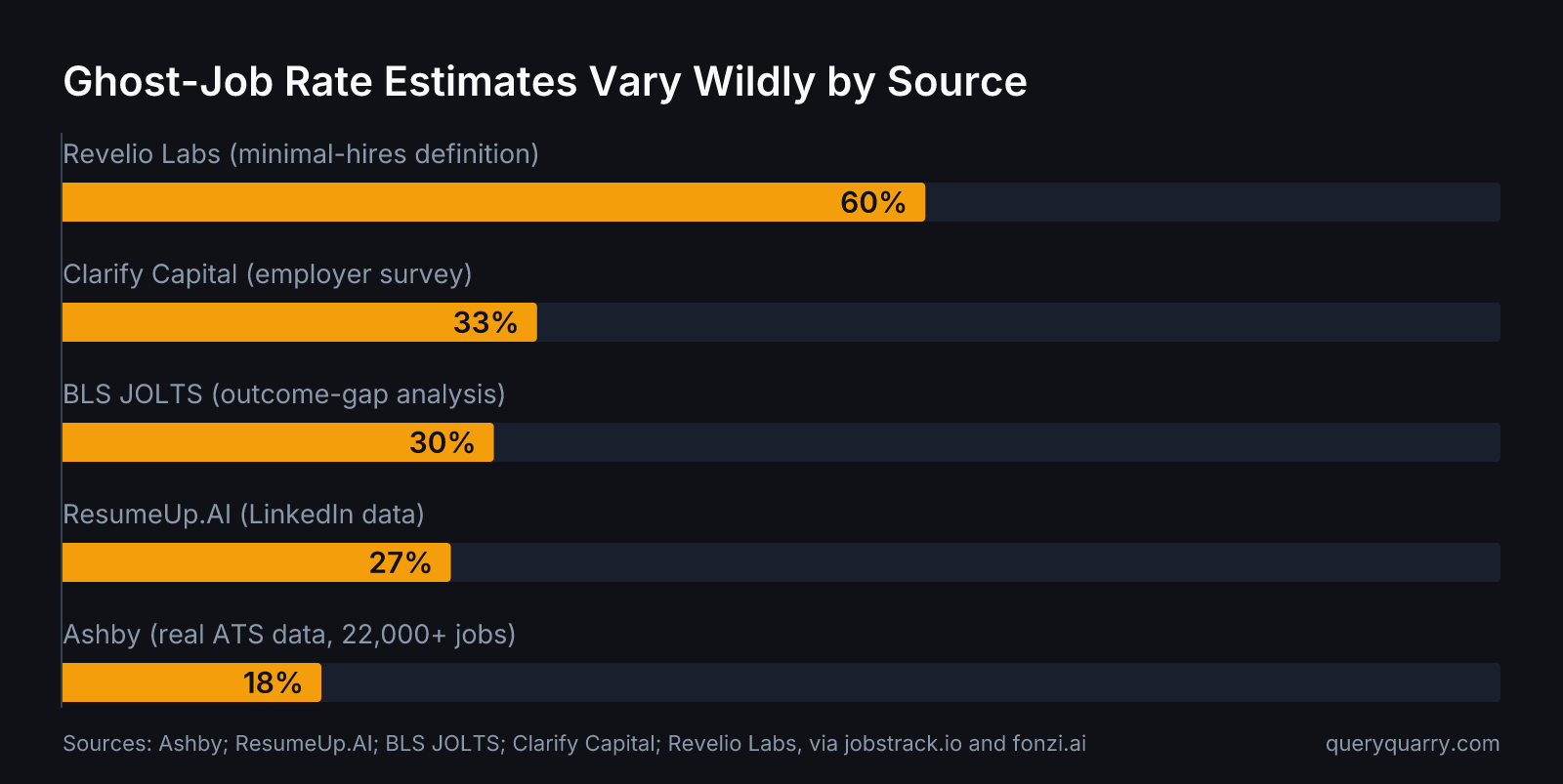
Meanwhile 93% of HR professionals admit their own employer posts ghost jobs, and the hires-per-posting ratio has halved since 2019, from 8 per 10 down to 4 per 10 — so whatever the exact rate, the trend line is unambiguous even when the number isn't. On the candidate side, the mood is just as contradictory: 61% of job seekers say AI has made the search easier than it was three years ago, while 92% simultaneously fear AI is shrinking the number of jobs available in their field. As Clutch analyst Hannah Hicklen put it: "This is a hiring arms race. Job seekers use AI to get past AI screening tools, and recruiters are using AI to sort through the volume that creates... The candidates winning right now aren't using AI the most; they're using it the smartest." Both sides feel the noise. Neither side has agreed on how big it is. That disagreement is itself evidence the fix isn't a better measurement — it's a different incentive.
Why the Industry's Fixes Only Patch One Side
Every proposed solution so far treats this as two separate homework assignments. Candidates are told to build portfolios, take skills assessments, and prove competence directly — and there's real evidence this works: McKinsey finds hiring for skills is roughly five times more predictive of job performance than hiring for education, and 85% of employers now say they use skills-based hiring practices. But dropping the credential filter doesn't remove the fakeable layer underneath it — Harvard Business School and the Burning Glass Institute found fewer than 1 in 700 hires were actually changed by dropped degree requirements, because the resume and interview performance around the skill claim are still infinitely cheap to fabricate. Even Canva's countermeasure — letting candidates use Copilot and Claude live, on a shared screen, during interviews — is a company-side patch on a candidate-side problem: it verifies process, not intent to actually work there.
Companies, meanwhile, are told to run curated marketplaces and ghost-job checklists — verify the listing is real, check how long it's been posted, confirm headcount was approved. That fixes exactly one half of the exposure problem and leaves the other half — a candidate corpus anyone can spam with AI-tailored noise — completely untouched. This mirrors the broader asymmetry we mapped across the verification industry: nearly every dollar of verification investment flows toward proving candidates are real, while almost none of it flows toward proving recruiters or postings are real. The two sides of the industry are building verification systems that never look at each other.
What Actually Costs Something
The honest objection here is that verification isn't worthless — a skills assessment does catch someone who can't write a for-loop, and a ghost-job checklist does filter out postings that have been live for 200 days. Content-level proof has real, if partial, value. But it doesn't touch the incentive, because the underlying exchange — I show you a claim, you decide whether to believe it, and neither of us pays anything to make the claim in the first place — is unchanged. A more convincing resume just raises the bar for what a fake resume looks like. A more convincing job posting just raises the bar for what a fake posting looks like. The arms race — the same one the recruiting-agent vendors are escalating from their side — doesn't end; it gets more expensive to run and produces the same noise at a higher production value — and it's worth remembering that the candidate holds more leverage in this than the pipe admits: they're the one deciding whether to respond at all, not merely the one being harvested.
The one lever nobody in this literature pulls is symmetry: making the act of becoming visible to the other party cost something, on both sides, at the same time. Not proof piled onto the candidate. Not a badge piled onto the listing. A cost — attention, commitment, reputation — attached to the moment either party asks to be seen, so that showing up with nothing behind it is no longer free. That's why personal referrals remain, as the data shows, the last hiring channel that hasn't been counterfeited by AI — not because referrals carry better information, but because a referral costs the referrer something if it's wrong. Nothing else in the current pipe carries that cost, which is exactly why it's the only channel that's still trusted on both ends.
Until visibility itself has a price tag attached — the same price tag, charged to whoever wants to be seen, whether they're posting a role or applying to one — ghost jobs and AI-stuffed resumes will keep escalating together, because they're not two problems responding to two fixes. They're one incentive, doubled.
Frequently asked questions
- Why do companies post job listings they don't intend to fill?
- Mainly to build a resume pipeline for later, signal growth to investors, or make current employees feel replaceable — reasons cited by 43% to 62% of hiring managers depending on the survey. This is the company-side mirror of candidates padding resumes: both exploit the fact that posting or applying costs nothing regardless of intent.
- Why are AI-generated resumes making it harder to get hired?
- Because when everyone can generate a keyword-optimized, tailored resume in seconds, the resume stops carrying any real signal about ability, forcing recruiters to screen even harder and candidates to counter-optimize further. This is the candidate-side half of the same arms race described in the post — free content production on one end mirrors free listing production on the other.
- Is there a way to stop ghost jobs and resume spam at the same time?
- Not through more verification content on either side alone — the fix has to attach a real cost to the act of becoming visible, applied symmetrically to postings and applications alike. That's the structural fix this post argues neither the candidate-advice literature nor the ghost-job reports currently propose, because both treat their half of the pipe as the whole problem.
Related
- AI Recruiting Agents Won't Fix Ghosting. Here's Why.
- Why AI Recruiting Tools Are Making Ghosting Worse, Not Better
- AI Hiring Fixes Miss the Real Problem: Recruiter Spam
- Hiring Fraud Checks Verify Candidates, Never Recruiters
- Is AI Resume Tailoring Candidate Fraud? The Real Answer
- AI Hiring Arms Race: Why Both Sides Keep Losing