
AI Recruiting Agents Won't Fix Ghosting. Here's Why.

Every major recruiting vendor this year is racing to bolt more AI recruiting agents onto the employer side of hiring — sourcing, shortlisting, verifying, texting — at the exact moment overall hiring is flat to declining. That's not a contradiction the vendors are hiding; it's a contradiction they haven't noticed, because their entire pitch depends on a growing target. Read the announcements from SHRM, Take2, Fusemachines, Eightfold, and AWS's own trust forum together, instead of one press release at a time, and a different story than any of them is telling shows up: this is an arms race over candidate ghosting, not a solution to it.
The Case for Agentic Everything
The framing is consistent across every source. SHRM's coverage of TA reinvention tells recruiting leaders they must plan for an agent-driven future as a baseline competency, not an experiment. Take2's healthcare webinar makes the pitch explicit: autonomous agents exist to scale recruiting without scaling headcount, running a 24/7 recruiting function even for scarce clinical roles. Fusemachines just announced an Agentic AI Suite with a Candidate Shortlisting Agent, a Pacing and Signal Agent, and — this is the one worth sitting with — a Candidate Trust Agent that flags AI-written resumes and application anomalies. Eightfold, meanwhile, rolled out a Candidate Agent that texts and WhatsApps candidates in 24-plus languages, explicitly framed as the answer to silence and ghosting. And an AWS-sponsored dinner at the Harvard Club just gathered 20 enterprises to discuss trust, governance, and deepfake interviews in the same hiring process everyone above is trying to automate.
Every one of these products names ghosting, silence, or fraud as the enemy. Every one of them proposes solving it with more automated contact and more automated verification, initiated by the employer, aimed at candidates who never asked to be found this way.
The Supply Side Nobody in the Press Releases Mentions
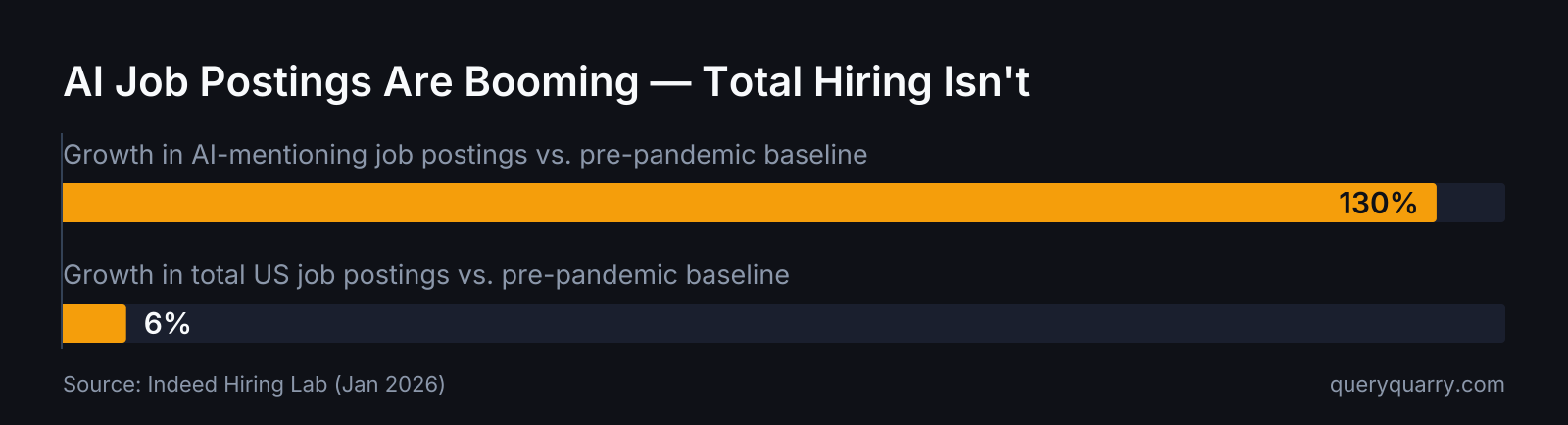
None of the five vendor stories cites a single labor-market number. That's convenient, because the numbers undercut the premise. Indeed's Hiring Lab shows total US job postings finishing 2025 just 6% above pre-pandemic baseline, with hiring paced at levels last seen between 2010 and 2013 outside the pandemic dip. The economy added a meager 57,000 jobs in June. Meanwhile postings mentioning AI surged more than 130% over the same stretch — a boom happening entirely inside a pool that isn't growing.
Drill into tech specifically and the target narrows further. Software development postings are up almost 15% since Claude Code launched in February 2025, but 71% of that increase is senior roles, and total tech postings still sit 34% below pre-pandemic levels even as AI-mentioning tech postings run 45% above them. This is the exact demographic — senior, AI-fluent software engineers — that every agent described above is being built to source, screen, and chase. It's a shrinking target getting hit by a growing number of automated hunters. Everyone else, like Suzanne Julien, laid off after 22 years in risk management and now locked out by AI-skill requirements she can't easily prove, is noise the bots aren't optimized to notice.
Why the Trust Agent Is the Tell
Fusemachines' Candidate Trust Agent is the single most honest artifact in this entire vendor wave, because it admits what none of the marketing copy says out loud: the industry's own AI created the problem its next AI now has to police. Candidate-side tools — resume optimizers, interview coaches — escalated to match employer-side screening the moment that screening went automated. So Fusemachines ships an agent to flag inconsistencies and anomalies across applications, resumes, and screening calls, and the AWS-sponsored forum spends an evening at the Harvard Club discussing deepfake interviews and identity verification as if they were unrelated developments rather than the direct output of the arms dynamic the room's own products created.
More verification doesn't reduce noise. It's another automated layer stacked on top of the automated layers already there, applied to a labor pool that Indeed's own data says isn't expanding to absorb it. These tools solve a volume problem nobody asked to have created in the first place, while leaving the actual signal problem — knowing whether a real match exists — untouched. And the verification apparatus itself has the blind spot we mapped last week: every dollar in the fraud crackdown flows toward proving candidates are real, never toward proving the recruiter or the role on the other end is legitimate. Trust, in this model, still only runs one direction — now with more agents.
Don't Faster Hiring Cycles Fix Ghosting?
The fair counterargument: Eightfold cites hiring cycles dropping from 42 days to under a week for early adopters. If agentic tools genuinely compress cycle time, that's a real efficiency gain, not just theater. But faster cycles for the recruiters who already have a shortlist don't fix ghosting for everyone else in the funnel — they just mean the winners get processed quicker while the flood of automated outreach and automated resume-parsing hits a wider net of candidates who were never going to make that shortlist. Speed for the few isn't the same as signal for the many, and none of the vendor data addresses what happens to volume, not velocity.
The Only Move Nobody in This Wave Will Make
Every agent described here — shortlisting, pacing, trust, conversational outreach — is built on one shared assumption: employers initiate contact, and candidates get identified, parsed, and verified before they have any say in it. That assumption is the entire business model for five separate vendors, which is exactly why none of them will question it. The structural fix isn't a smarter bot chasing the same shrinking pool of senior engineers harder, or a trust layer patching the fraud that automated screening incentivized. It's removing the reason to spam in the first place — keeping candidates unidentifiable until they decide to surface. That's not a feature roadmap any of these five companies can ship, because it requires giving up the thing their agents are built to do: find you before you're ready to be found.
Frequently asked questions
- Why are recruiting companies launching AI agents when overall hiring is flat or declining?
- Because vendor growth depends on selling more automation regardless of whether the underlying job pool is expanding, and Indeed's data shows total postings sit just 6% above pre-pandemic levels while AI-mentioning postings surged over 130%. That mismatch is the core tension this post traces across five 2026 vendor announcements.
- Do AI recruiting tools like Eightfold's Candidate Agent actually reduce candidate ghosting?
- They add more automated employer-initiated contact channels, but they don't address why candidates go silent, which is exposure and volume rather than a lack of messaging options. Eightfold names ghosting as the enemy but proposes the same employer-controlled contact model that produces it.
- What is Fusemachines' Candidate Trust Agent and why do recruiters suddenly need one?
- It's an AI agent that flags inconsistencies and anomalies across resumes and applications, built because AI-written resumes and interview coaching have escalated to match automated employer-side screening. Its existence is the clearest evidence in this vendor wave that recruiting AI is now built to catch the candidate-side AI the industry's own tools helped provoke.
Related
- Why AI Recruiting Tools Are Making Ghosting Worse, Not Better
- AI Hiring Fixes Miss the Real Problem: Recruiter Spam
- Hiring Fraud Checks Verify Candidates, Never Recruiters
- Ghost Jobs & Fake Resumes: Same Broken System, One Fix
- Is AI Resume Tailoring Candidate Fraud? The Real Answer
- 2026 HR Tech Boom Optimizes Speed, Not Candidate Consent