
AI Hiring Fixes Miss the Real Problem: Recruiter Spam

Every response to AI-flooded hiring pipelines — fraud summits, proctored exams, audit trails, outbound sourcing platforms — happens after contact has already occurred. That's the tell. AI hiring verification doesn't stop recruiter spam; it relocates it, redirects it, or documents it after the damage is done. Nobody has tried the one move that would actually prevent the flood: gating volume at consent, before either side reaches out.
The Flood Just Changed Direction
Start with the mechanical cause everyone agrees on. AI writing tools have pushed hiring teams to roughly four times as many applications as they saw before generative AI went mainstream. Allen Liao, co-founder of Obra, puts it plainly: "When every resume is polished by the same AI tools, the inbox stops telling us who is truly the right fit." A senior recruiter at Aloden describes getting hundreds of thousands of AI-generated applications and responding by shifting budget toward outreach instead.
That shift is the whole industry's answer, dressed up as innovation: give up on inbound entirely and go find candidates yourself. Obra Hire now offers search across more than 800 million candidate profiles, complete with verified contact information, and LinkedIn research cited in the same piece shows 83% of recruiters expect passive-candidate engagement to matter more, not less. Read that plainly: the fix for inbound application spam is outbound recruiter spam, just aimed at people who never asked to be found. The volume didn't shrink. It just started arriving in a different inbox — yours, unsolicited, whether you're looking or not.
Consent gating: preventing unwanted contact before it happens, instead of verifying, auditing, or redirecting it after the fact.
Every other fix in this ecosystem operates downstream of contact. Consent gating is the only lever that operates upstream of it — and as far as the current tooling landscape goes, it's untouched.
Proving Legitimacy After the Fact
The enterprise response looks more sophisticated, but it's chasing the same tail. Crosschq convened an invitation-only AI Hiring Fraud Summit in Napa Valley with leaders from AAA, ADT, AT&T, Google, PNC, Salesforce, Wells Fargo, and Workday, responding to warnings that state-sponsored operatives — including remote IT worker programs linked to North Korea — and organized fraud networks are actively infiltrating hiring pipelines. Gartner projects one in four candidate profiles worldwide will be fraudulent by 2028. Crosschq CEO Mike Fitzsimmons says the sophistication of these attacks is "accelerating every quarter," and ID.me's Taylor Liggett frames the fix as identity verification becoming "foundational to every hiring decision."
Notice what that verification apparatus never asks: whether the contact should have happened at all. It only asks whether the person who showed up is who they claim to be. Workera takes this to its logical extreme, declaring the resume dead as a signal and replacing it with proctored, AI-monitored skill exams — CEO Kian Katanforoosh argues Workera "replaces resume screening and inferred skill matching with verified proficiency at the point of hire," a system that has already verified more than 180,000 skills for a single professional services firm. Audit-trail tooling extends the same logic into compliance: HR teams are being told to generate evidence for every automated screening decision, and even solo recruiters are building auditable prompt playbooks to force manual proof into their own sourcing — proving this isn't a Fortune 500 problem, it's felt at every scale.
All of that infrastructure — summits, proctoring, audit trails, prompt discipline — proves legitimacy after contact. It's the same one-directional trust burden we've written about before: every dollar of the fraud crackdown goes toward proving candidates are real, and none of it goes toward proving recruiters or the volume they generate deserve to reach anyone in the first place.
The Culprit Enhancv Can't Agree On
Here's where it gets uncomfortable for the industry's own diagnosis. Enhancv surveyed 1,066 U.S. job seekers and found 50.5% were rejected at least once without a single word from a human, 68.5% say AI involvement was never disclosed, and 31.4% now abandon applications specifically to dodge automated screening. Co-founder Volen Vulkov's conclusion: "trust in the hiring system breaks down completely" when candidates can't tell if a person or an algorithm read their resume.
But Enhancv ran a second study — interviewing 25 recruiters directly across Workday, iCIMS, Greenhouse, Bullhorn, and more — and it says almost the opposite thing. 92% of those recruiters said their systems don't auto-reject resumes for content, formatting, or design. Only 8% had AI/content auto-rejection configured at all. When asked where the "ATS silently rejects you" myth comes from, 68% pointed to job seekers repeating claims they saw on LinkedIn or TikTok, not to anything their own systems actually do. Allegis's Charkin Whitehead put it bluntly: "The ATS systems that I've worked with don't automatically disposition people — we have to go in and do it."
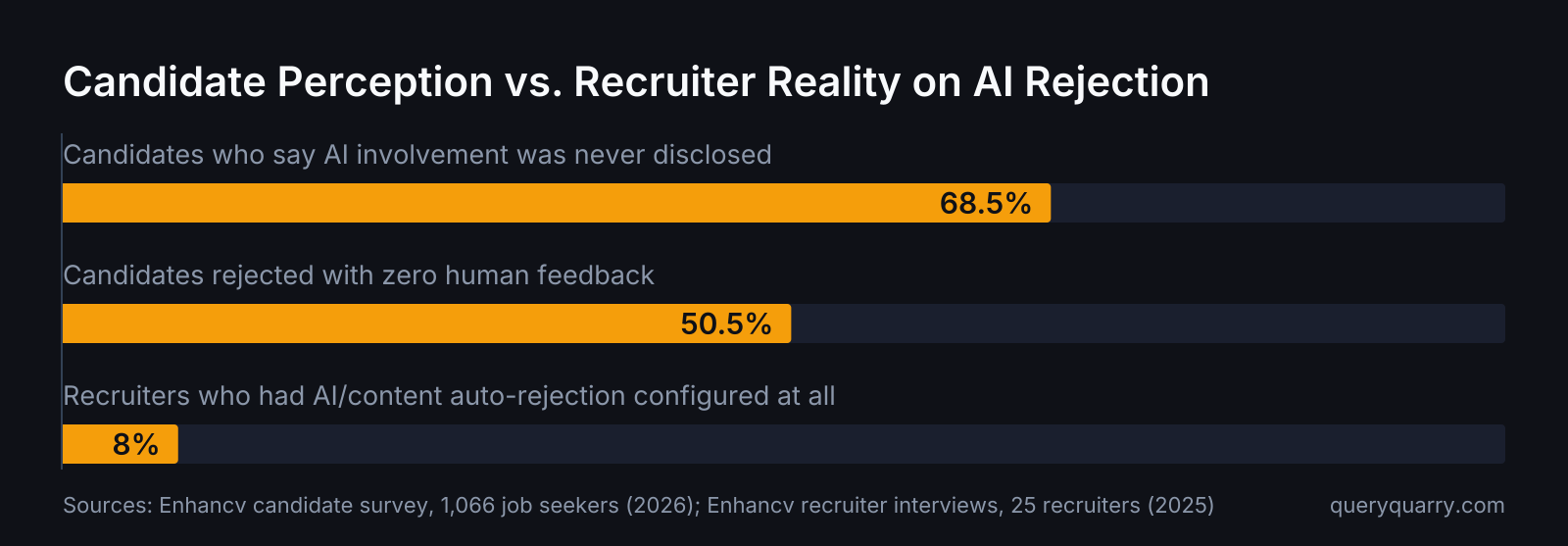
Put those two studies side by side and the industry's own data contradicts its own diagnosis. Candidates believe a cold algorithm made the call. Recruiters say the real cause is human teams drowning under four times the application volume, manually triaging what they can and going silent on the rest. If that's true, then every disclosure requirement, every audit trail, every "tell candidates AI was involved" policy is aimed at a machine that isn't actually the bottleneck. It's treating a symptom of overload as if it were a decision — the same misdiagnosis we flagged when AI recruiting tools kept optimizing for volume instead of the ghosting it produces.
Nobody Has Tried Gating at Consent
Strip away the summits, the proctoring, the outbound targeting, and the disclosure debates, and you're left with one structural fact: every fix in this ecosystem intervenes after two parties are already in contact. Fraud detection verifies the candidate after they've applied. Proctoring verifies skill after the interview is booked. Audit trails document a decision after it's made. Outbound sourcing just swaps which party gets flooded. None of it asks the earlier question — should this contact happen at all, and who gets to decide? That question keeps landing on recruiters, when candidates are the ones actually holding the leverage nobody's asking them to use.
The honest objection here is that consent gating sounds like it just shrinks the funnel, and recruiters need volume to find rare skills; a pool where candidates opt in before anyone can reach them risks starving legitimate searches of exactly the people companies are trying to hire. That's fair when the goal is casting the widest possible net. But the data above shows wide nets are exactly what broke hiring — four times the volume didn't produce better signal, it produced 85% of candidates left guessing whether a human ever looked at their resume and recruiters manually drowning in applications a machine was supposed to filter. A narrower, opt-in pool that only surfaces candidates who've already agreed to be found isn't a smaller funnel — it's a funnel with fewer wasted cycles on both ends, because consent, not volume, was the filter this whole system forgot to build.
Every layer of this industry — enterprise, mid-market, solo recruiter — is still building better locks for a door that's already been kicked in. The volume race was never a strategy; it was what's left when nobody has to ask before knocking.
Frequently asked questions
- Do ATS systems really auto-reject resumes because of AI content or formatting?
- Rarely — 92% of the 25 recruiters Enhancv interviewed said their ATS platforms don't auto-reject resumes on content or formatting, and only 8% had AI-based content rejection configured. This directly contradicts the candidate-side belief examined in the post that a cold algorithm is silently filtering resumes, pointing instead to human bandwidth collapse.
- Why are job seekers getting silently rejected without any human feedback?
- Enhancv's recruiter interviews suggest it's mostly overwhelmed human teams, not automated judgment — 50.5% of candidates report silent rejections, but recruiters say the volume, not the algorithm, is the bottleneck. That contradiction is central to the post's argument that the industry's disclosure and audit-trail fixes may be aimed at the wrong culprit.
- Does giving recruiters outbound access to millions of candidate profiles fix the AI application flood?
- No — it relocates the flood from resume inboxes to candidate inboxes, replacing application spam with recruiter spam. The post uses Obra's 800-million-profile outbound platform as the clearest example of the industry redirecting volume instead of preventing it.
Related
- AI Recruiting Agents Won't Fix Ghosting. Here's Why.
- Why AI Recruiting Tools Are Making Ghosting Worse, Not Better
- Hiring Fraud Checks Verify Candidates, Never Recruiters
- Ghost Jobs & Fake Resumes: Same Broken System, One Fix
- 2026 HR Tech Boom Optimizes Speed, Not Candidate Consent
- The ATS Resume You Optimized Is Also a Surveillance Target