
2026 HR Tech Boom Optimizes Speed, Not Candidate Consent

Five HRTech launches hit within weeks of each other in late 2025 and early 2026, and every one of them measures the same thing from the same side of the table: how fast and how much a recruiter can push at candidates. None measures whether candidates asked for it. That's the recruiting automation candidate experience gap sitting underneath this whole product cycle. The vendors didn't forget to fix it; it's a cost nobody on the sending side has to pay.
Where Is the Recruiting Automation Candidate Experience Gap Hiding?
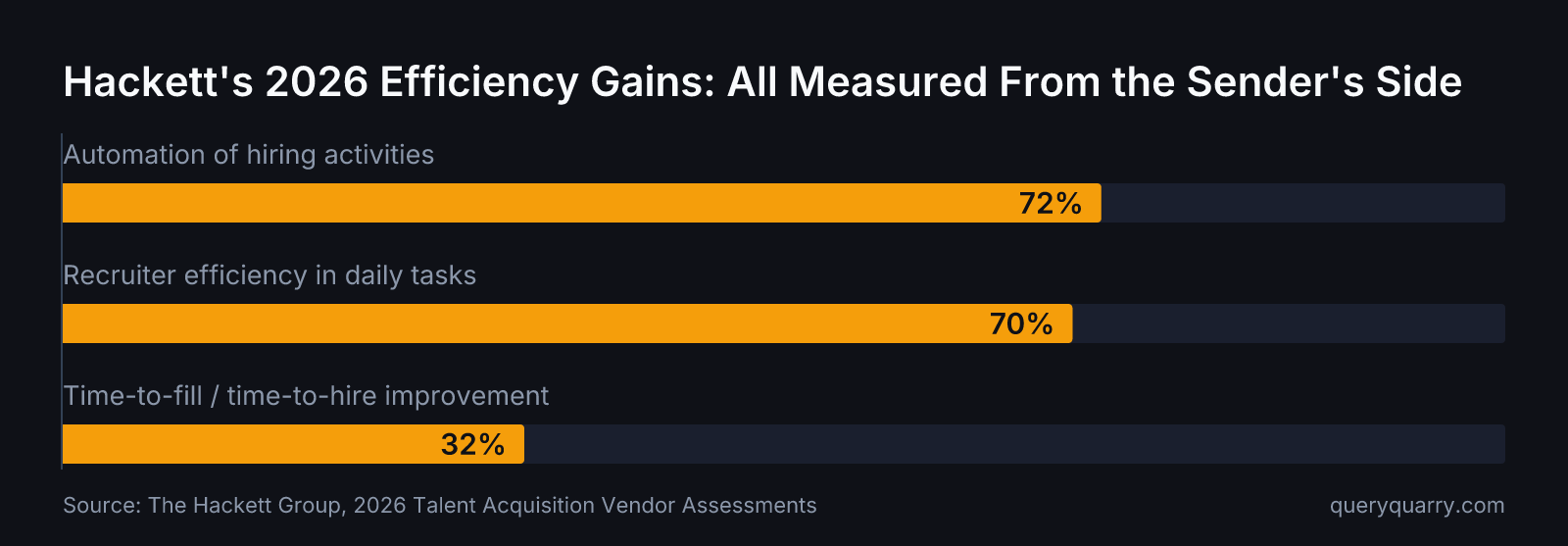
Start with the numbers vendors actually lead with. Payscale's JobNav Recruiter takes a job posting from draft to published in under 30 minutes, and customers report cutting workflow time in half while filling roles 18 days faster. The Hackett Group's 2026 Talent Acquisition Vendor Assessments put a number on the whole category: automation of hiring activities improved by 72%, recruiter efficiency rose 70%, and time-to-fill dropped 32%. A year earlier, Hackett's 2025 Digital World Class Matrix had already logged 38% faster time to fill and 46% more qualified applicants. The trend line across both years is identical: more throughput, faster cycles, bigger reach, all of it measured from the sender's side of the pipe and none of it from the receiver's.
That one-way orientation is the design. ATS Mako crossed 1,000 recruiters selling exactly this: a platform built for managing hundreds of applicants and sending thousands of messages — volume as the capability being sold, not a risk being flagged. Aptimal brings the same industrial-scale outbound tooling (AI resume parsing, automated client briefings, technical assessments) downmarket to boutique staffing agencies that used to run everything by hand. The volume that used to require an enterprise TA team is now available to a two-person shop. Nobody in either announcement asks what happens to the inbox on the other end of a thousand automated messages, because volume is the product being sold, and the person receiving it has never once been the customer.
Does Hackett's 2026 Vendor Report Actually Track Candidate Experience?
Here's the part that undercuts the industry's own excuse. Hackett doesn't ignore candidate outcomes: its vendor-assessment methodology explicitly rates 12 providers across 28 criteria that include candidate experience and candidate diversity, and the full Digital World Class Matrix report covers 15 providers on cost-per-hire, time-to-fill, and quality of hire alike. The data exists. It's collected through vendor briefings and customer interviews, same as the speed numbers. What doesn't happen is any of it surfacing in a headline. The press releases lead with 72% automation and 32% faster fills because that's what sells software to a buyer whose own workload is rising. Hackett's 2026 HR Key Issues data shows organizations expecting a 9% increase in workload against shrinking headcount and budget, which is precisely why they're increasing tech spend by 9% to compensate. Candidate experience sits in the rubric because it's measurable, not because anyone downstream plans to act on it.
We've made a version of this argument before about the fraud side of the same system: every dollar in the 2026 hiring-fraud crackdown flows toward proving candidates are real, never toward verifying recruiters. The pattern repeats here. The measurement apparatus always points at the sender's throughput, never the receiver's consent. Consent doesn't show up in a product demo; throughput does.
Verified Skills Data Still Doesn't Mean Verified Consent
The newest wrinkle makes the asymmetry more literal. Workera's partnership with Kombo pipes verified skills data into more than 200 HRIS and ATS platforms through a single connection. The stated problem is real: Gartner data cited in the announcement shows only 33% of business leaders trust their current talent data, and insufficient data creates roughly a 20% drag on operational efficiency, while BCG's research finds 80% of AI initiatives fail because leaders mistake tool access for actual capability. Fair problems, real fixes. But notice what's missing from the pitch entirely: whether the candidates whose skills now flow through 200 connected platforms ever agreed to that flow. Verification solves a trust problem for the buyer. It does nothing for the person being verified, who still doesn't get a say in who sees the data, when, or through how many downstream systems it travels next.
Stack all five launches together and the shape of the industry gets easier to see. Faster job posting, higher automation scores, thousand-message send limits, verified skills piped everywhere at once: every metric describes how efficiently a recruiter can reach a candidate, and not one describes whether that candidate wanted to be reached. That asymmetry is the whole business model of volume recruiting, and it's exactly why the model is running out of runway: the more efficient the sending gets, the more the receiving end tunes it out, deletes it, or blocks it outright. Efficiency measured only on one side of a two-sided exchange isn't a growth story. It's a countdown.
Frequently asked questions
- Why does faster recruiting technology lead to more candidate ghosting?
- Because speed and automation multiply outbound volume without adding any mechanism for candidates to opt in, pushing response demand past what people can or will answer. The 2026 launches in this post all optimize for throughput — 30-minute postings, 72% automation — while tracking nothing about how candidates experience the resulting flood.
- What is candidate consent in AI recruiting tools, and why don't most platforms measure it?
- Candidate consent means a candidate chooses when and whether to engage with outreach rather than being passively targeted by automated systems, and most platforms skip measuring it because no published benchmark includes an opt-in or response-rate metric. Hackett Group's own 28-criteria rubric rates candidate experience internally, but that number never appears in the efficiency statistics vendors actually promote.
- Does The Hackett Group's 2026 talent acquisition vendor assessment track candidate experience?
- Yes — Hackett's methodology rates candidate experience and candidate diversity among its 28 assessment criteria across 12 providers. That data exists behind closed doors, but it's buried relative to the speed and automation percentages that dominate the public press releases covered in this post.