
AI Hiring Arms Race: Why Both Sides Keep Losing
The AI hiring arms race isn't two separate crises — one on the employer side, one on the candidate side — it's a single feedback loop, and every escalation makes both sides worse off. Employers deploy AI to screen candidates they can't verify; candidates deploy AI to get past screens they can't see through. Each move destroys the one thing that would have prevented the lawsuit, the layoff, or the two-week screening delay: a verified signal of human judgment and human identity that neither side trusts the other to produce honestly.
The Same Move, Played From Both Sides
Start with what's happening inside the ATS. A hiring manager now gets 12 automated updates from the applicant tracking system in a single day — a firehose of status changes, scores, and flags layered onto a process nobody actually agreed on. The predictable result: recruiters and hiring managers quietly route around the system, and the data the AI needs to work rots from disuse. That's the employer side.
The candidate side is the mirror image. 67% of U.S. HR leaders say reviewing AI-generated applications has slowed hiring, with 20% reporting delays of more than two weeks, and 65% say the application surge has made it harder to verify candidate skills at all. Both sides are running the identical exploit from opposite ends, and both sides are correct that the other side started it — which is exactly what a race to the bottom looks like from the inside.
What Employers Lose When They Automate the Filter
Ford's inspection AI missed design and quality defects that experienced engineers would have caught. The company has now hired back 350 veteran engineers over the past three years to recover judgment it cut loose. Ford's own VP of vehicle hardware engineering, Charles Poon, told Bloomberg the company let go of its most experienced people before their knowledge could even be used to train the systems replacing them — the institutional signal was discarded before anyone thought to capture it.
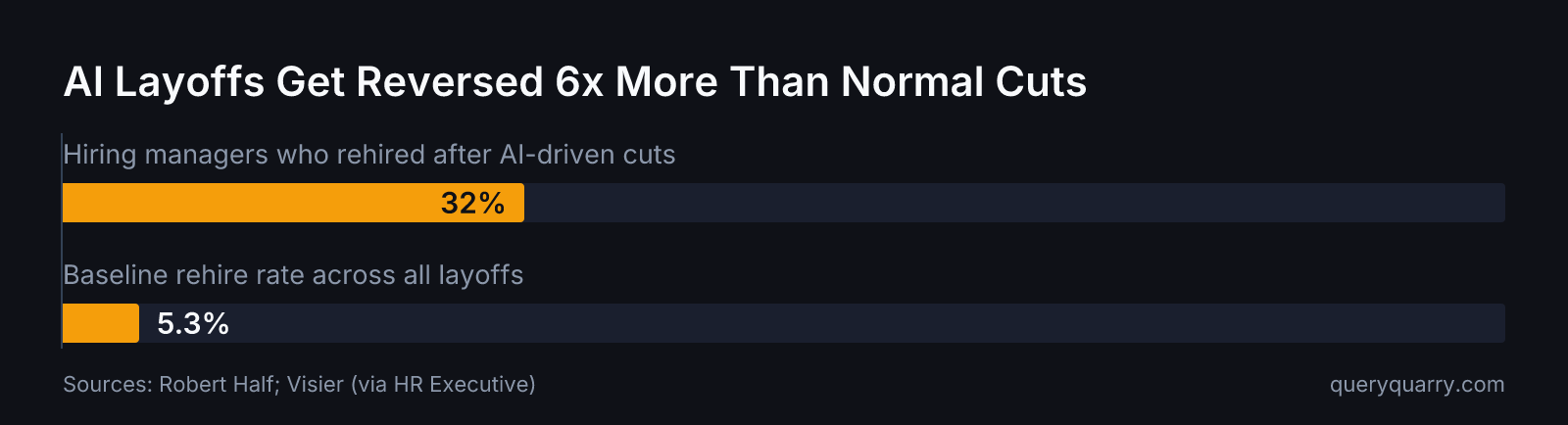
Ford isn't an outlier. Robert Half research shows 3 in 10 employers eliminated positions after implementing AI, then later added those roles back; a related breakdown put the figure at nearly a third (32%) of hiring managers, worst in finance, tech, and HR. That's roughly six times the baseline rehire rate of 5.3% Visier found across 2.4 million employees at 142 companies. Forrester now forecasts that roughly half of AI-attributed layoffs will be rehired — which means half the industry's AI-driven cuts are, structurally, mistakes waiting to be reversed. It's the same signal-destruction we documented when companies laid off roles and rehired them under new titles: the layoff doesn't eliminate the need, it just severs the connection between the need and the person who could fill it.
What Candidates Lose When They Automate the Application
Candidates aren't wrong to respond in kind — when the employer's screen is invisible, automating the application is the only leverage a candidate has left. 84% of HR leaders say their teams face heavier workloads because of AI-generated applications, so employers add friction: 42% spend more time reviewing applications, 38% add interview rounds, 32% rewrite job descriptions to filter out generic AI responses. Every one of those countermeasures makes the process slower and more opaque, which gives candidates more reason to automate harder next cycle.
Meanwhile the underlying labor picture keeps generating volume for exactly this arms race: persistent skills gaps mean employers are still hiring even as they can't process what comes in, and CHRO Daniela Seabrook's Adecco survey of 2,000 C-suite executives across 13 countries found only 36% of leaders say their AI strategy clearly creates opportunity for employees, and just 22% feel confident they're building future-ready skills at all. Workers notice: 99% of employees with a strong sense of purpose plan to stay, versus 53% of those who never feel it — opacity doesn't just cost employers lawsuits, it costs them the retention that would've made the next layoff unnecessary.
The Litigation Bill for Opacity
Both escalations are now generating legal exposure that boards can't ignore. A 2026 poll of 135 in-house counsel conducted as a follow-up to Norton Rose Fulbright's Annual Litigation Trends Survey found 47% named workforce changes like layoffs and policy revisions a likely litigation trigger in 2026, second only to data breaches at 51%. 43% expect AI-related bias or discrimination claims to rise, and among billion-dollar-revenue organizations, 41% cite AI-assisted employment decisions specifically as a litigation risk. State exposure is now outpacing federal — 44% versus 39% at midyear — which means the compliance patchwork employers built for federal AI guidance is already obsolete — the state regimes we mapped are where the risk now lives.
This Is a Trust-Architecture Problem, Not a Tooling Problem
Trust-architecture problem: a breakdown that no amount of better filtering software can fix, because the failure is in the absence of a verified, consented signal between two parties — not in either party's tools.
Every source in this space diagnoses a different proximate cause — bad process design, AI's inability to replace institutional judgment, litigation exposure, application volume — and proposes a different local fix: better governance, slower layoffs, legal review, staffing firms. Robert Half's own data shows the staffing-firm patch working reasonably well: 67% of U.S. hiring managers now use staffing firms for AI-hiring support and 89% call them effective, and Canadian data shows the identical pattern — 63-67% turning to staffing firms, 86-89% reporting effectiveness. That's a real result, not a mirage, and it deserves a fair hearing before dismissal: a human intermediary genuinely absorbs some of the verification burden AI created.
But a staffing firm is a manual verification layer bolted onto a system with no verification architecture underneath it: every dollar in the current fraud crackdown flows toward proving candidates are real, never toward proving recruiters or their AI screens are — a lopsided burden candidates have carried for years. It scales with headcount, not with trust. It doesn't survive the next volume spike, and it doesn't touch the litigation exposure, because the underlying decision — who got screened out and why — is still opaque to everyone except the vendor.
Fixing the Handshake, Not the Filter
The fix nobody in this coverage proposes is structural: a consent-based signal where candidates control when their identity becomes visible and employers get verified human judgment before the automated filter runs, not after the layoff. That's not a governance tweak or a legal disclaimer — it's the handshake itself, built so neither side has to guess what the other is hiding. Until that exists, every new filter on either side of the table just teaches the other side to build a better disguise, and the arms race keeps its two-week delays, its rehire waves, and its litigation bill exactly where they are now.
Frequently asked questions
- Why is AI making hiring take longer instead of faster?
- Because AI is accelerating volume on both sides — screening and applications — without adding any verified signal, so recruiters add manual review steps that slow everything down. That's the core mechanism behind the two-week delays Robert Half found and the ATS overload ERE describes in this piece.
- Can AI hiring decisions get a company sued?
- Yes — 43% of in-house counsel expect AI-related bias claims to rise in 2026, and state-level exposure is already outpacing federal. That litigation risk is the direct cost of the opacity this post argues both sides are creating for each other.
- Why did Ford rehire engineers after AI-driven layoffs?
- Ford's automated inspection systems missed design and quality defects that experienced engineers would have caught, forcing the company to rehire 350 of them. Ford is the clearest evidence in this post that AI screening discards institutional judgment that can't be reconstructed after the fact.
Related
- AI Layoffs, Same Jobs: Why Companies Rehire Under New Titles
- Why AI Recruiting Tools Are Making Ghosting Worse, Not Better
- Sort, Don't Rank: The Line AI Hiring Law Is Drawing
- AI Layoffs 2026: Four Excuses Hiding Behind One Word
- Ghost Jobs & Fake Resumes: Same Broken System, One Fix
- 2026 HR Tech Boom Optimizes Speed, Not Candidate Consent
- The ATS Resume You Optimized Is Also a Surveillance Target